
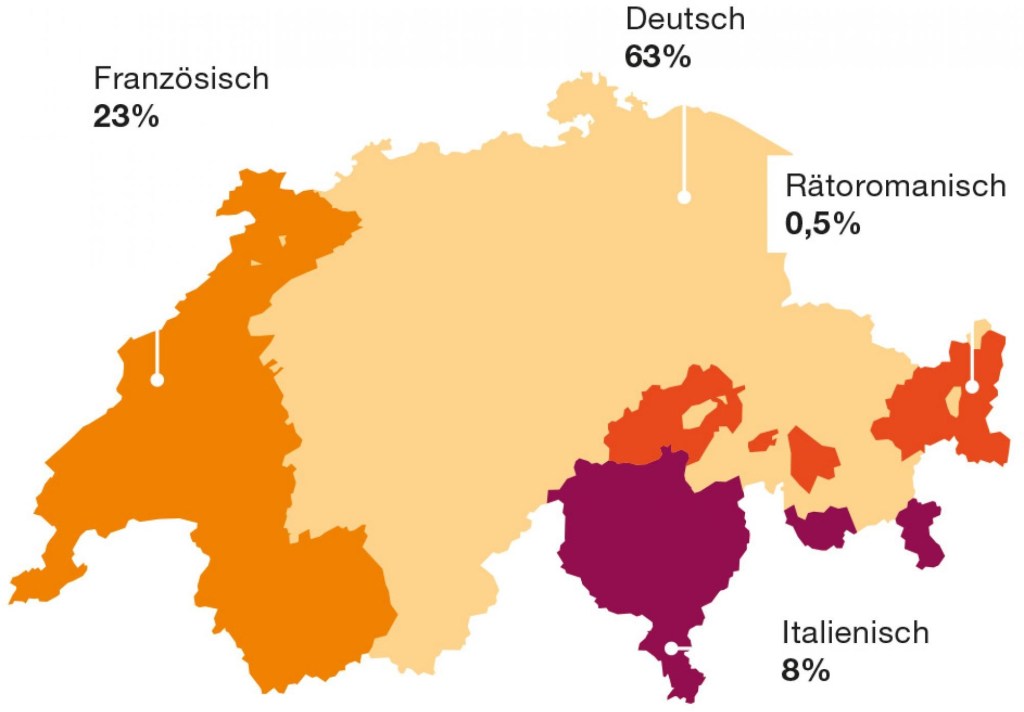
What languages are spoken in Switzerland and where?
The 4 languages
We have four official languages: German, French, Italian and Romansh. However, this does not mean that all Swiss speak every one of these languages. Most can do two or three. The most common is German (about 63%), then French (about 23%) and Italian (about 8%). Romansh is spoken by only 0.5% of the population.
And what about Swiss German?
Swiss German is a dialect of German. This means that people who have German as their mother tongue learn both. Swiss German is the spoken language and High German is the written language. On television or at public events you can find both, some things are in Swiss German and others in High German. Most of the time, however, such occasions are in High German to make sure that even people who do not speak Swiss German understand it. Even if you attend a fitness course or further training, you are usually asked at the beginning whether Swiss German is good for everyone or whether someone does not understand it.
Differences of cantons
Switzerland is divided into 26 cantons. The majority of the cantons are monolingual, e.g. in the canton of Zurich only German is spoken (i.e. spoken Swiss German as well as written/official High German). But there are also bilingual cantons, such as the canton of Bern, where German and French are spoken, depending on the municipality or city. Most of the canton of Bern is German-speaking, but there are cities where people speak German and French, such as Biel/Bienne. This is because Biel borders on the French-speaking canton of Jura.
What languages do they teach in Swiss schools?
In Swiss schools, lessons in the German-speaking part are in Swiss German or High German. The second foreign language is not uniformly regulated. The cantons that are closer to the French-speaking cantons learn French as a foreign language first and then English. In the north-eastern cantons, English is first and then French. And the French-speaking cantons learn German and then English. This is again a typical situation for Switzerland, which you will surely get to know soon: Different rules apply in each canton.
 SIMPLY SWISS GERMAN